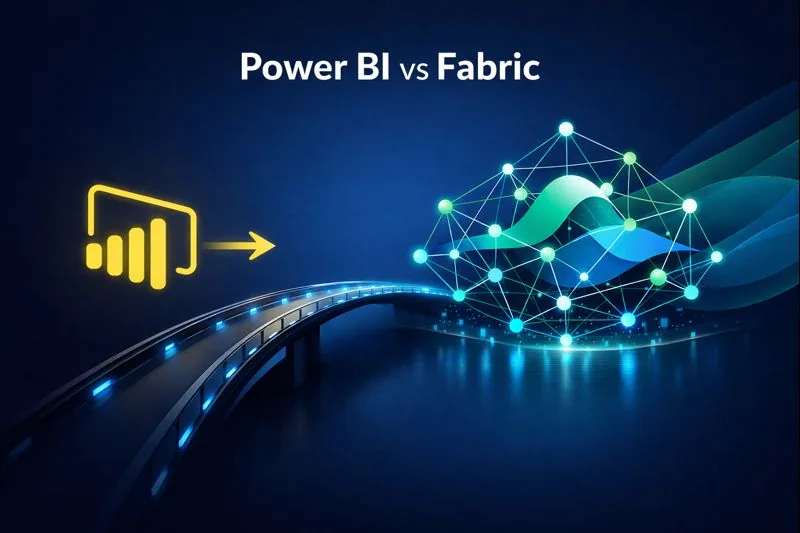
Power BI Pro vs Microsoft Fabric: When does it make sense to switch?
 Arsénio Ferraz
 One of the questions we've heard most in recent months is simple: "If I only use Power BI Pro, do I really need to switch to Microsoft Fabric now?". The direct answer is: in most cases, no. And this is precisely where many organizations are getting stuck in unnecessarily complex decisions.
Power BI Pro is still sufficient for many scenarios
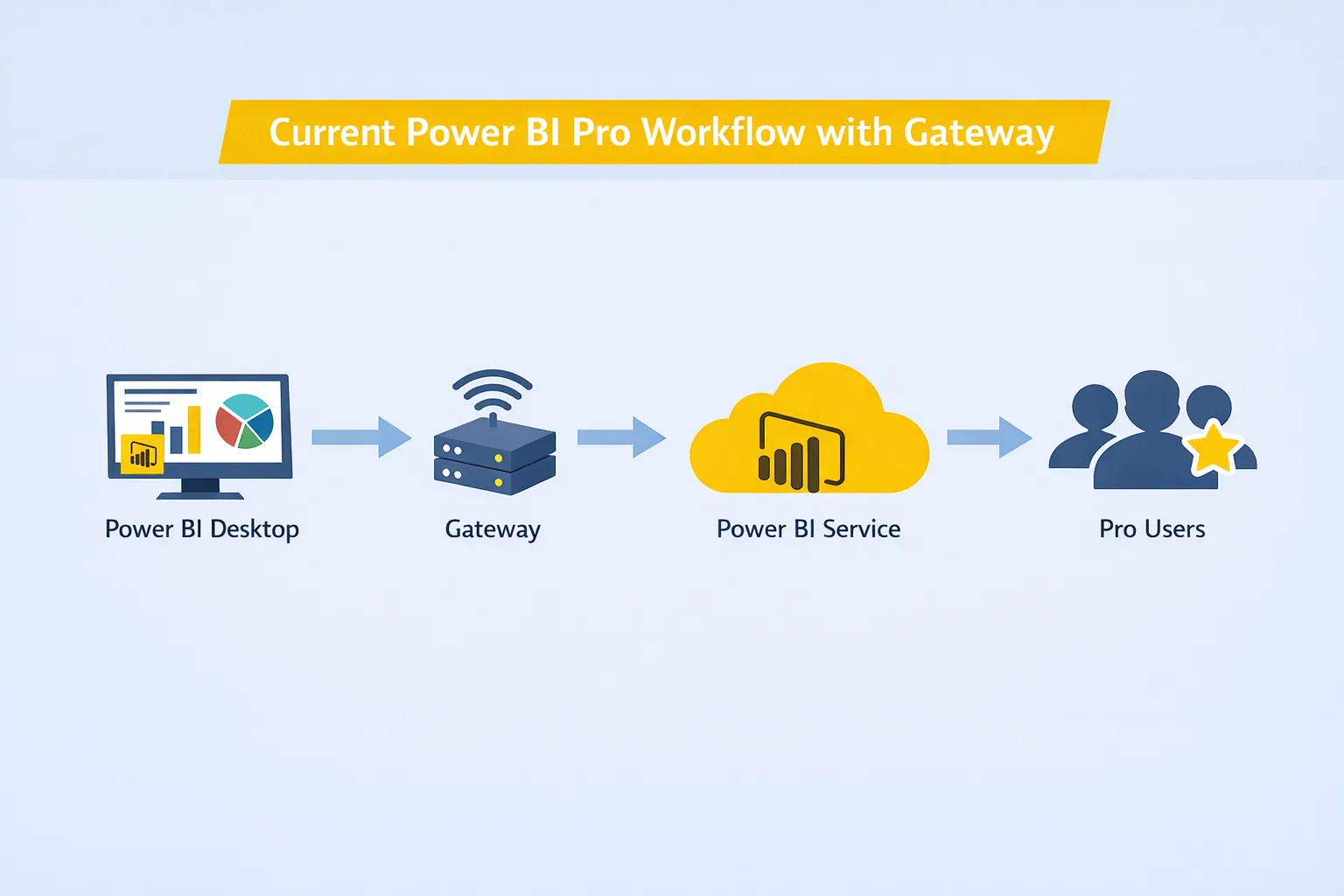
For many companies, the current scenario is this: 1 or a few users with a Power BI Pro license, reports built in Power BI Desktop, connection to SQL Server on-prem via gateway, and scheduled refresh in the service.
This model remains fully supported, is stable and, for small teams, is usually the simplest and most economical option.
What really changes with Microsoft Fabric
Microsoft Fabric doesn’t replace Power BI, it expands it: it’s a complete data platform (OneLake, lakehouse, data warehouse, data engineering, real-time, etc.) where Power BI is just one of the workloads.
At the same time, the old Power BI Premium per capacity model is being replaced by Fabric capacities (F-SKUs), which are becoming the natural path for those who need scale and a unified data platform.
When it makes sense to stay on Power BI Pro
At Avantit, the advice is clear: don’t “force” Fabric if the client doesn’t yet have more advanced data platform requirements.
As a general rule, Power BI Pro continues to be the right choice when:
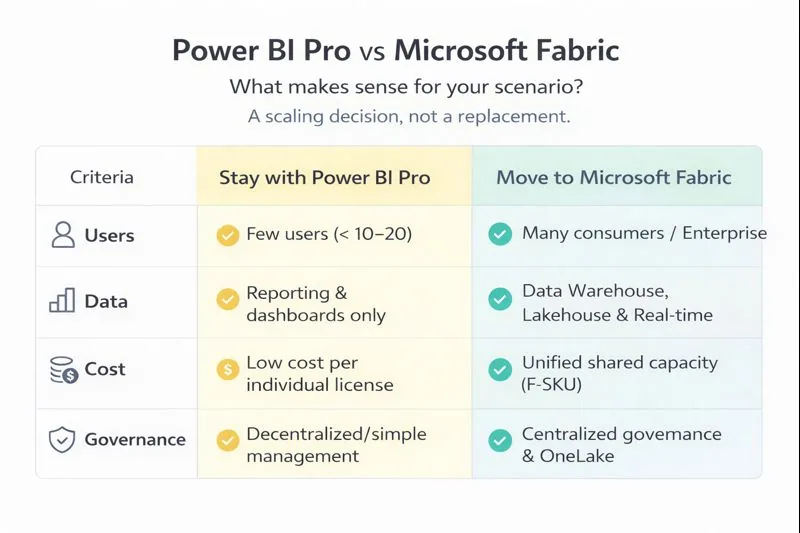
- There are few users (creators and consumers) and the cost per user remains fully acceptable compared to the cost of a Fabric capacity.
- The main goal is reporting and dashboards, without major need for data engineering, lakehouse, or real-time analytics.
- Current integrations (like SQL on-prem via gateway) work well and without critical performance or governance limitations.
When to start looking seriously at Microsoft Fabric
Fabric starts to gain traction when the conversation stops being “just reporting” and becomes “data platform”.
Some clear signs that it’s time to evaluate this evolution:
- Many “view-only” consumers, to the point where a Fabric capacity (e.g. F64+) is more efficient than dozens or hundreds of individual Pro licenses.
- Need for a centralized and governed data model, reusable by multiple teams and domains (finance, commercial, operations, etc.).
- Interest in consolidating workloads like lakehouse, data warehouse, pipelines, notebooks, and real-time analytics into a single SaaS service – without setting up and orchestrating everything manually in separate Azure services.
How Avantit can help you decide the right path
In practice, the most important thing is not “if” there should be Fabric, but “when” and “in what form”. At Avantit, we typically follow three simple steps with clients:
1. Diagnosis
Assessment of users (creators vs consumers), data sources (on-prem vs cloud), and current issues with cost, performance, and security.
2. Profiling
- Micro/Small: less than 10 users → optimize what already exists in Power BI Pro and gateway, maintaining the current model.
- Medium: dozens of viewers/various domains → evaluate Power BI Premium per user (PPU) or a small Fabric capacity for a pilot.
- Enterprise: many creators and hundreds of consumers → design a Fabric architecture with dedicated capacities and a phased migration roadmap.
3. Phased Plan
Start by stabilizing the current Power BI landscape, choose a pilot domain for Fabric (e.g., sales), and only then scale the approach to the rest of the organization.
If your organization is also in this dilemma between staying on Power BI Pro or moving to Microsoft Fabric, Avantit can support you with a quick and objective assessment, focused on cost, capacity, and data roadmap.
Just contact us to schedule a diagnostic session and, in a few hours, you will have a clear plan on what the next smartest step is for your context.
Editorial Policy
At Avantit, we value authenticity and human expertise. This article was written and reviewed by our experts, ensuring technical accuracy grounded in real-world projects. We do not publish content generated exclusively by AI without validation by one of our consultants.
Share and Comment
Related Topics
If this sounds familiar because it is your problem, not just curiosity:
Data and analytics servicesEnjoyed this article?
Subscribe to our newsletter to receive more content like this or contact us to learn how we can implement these solutions in your company.